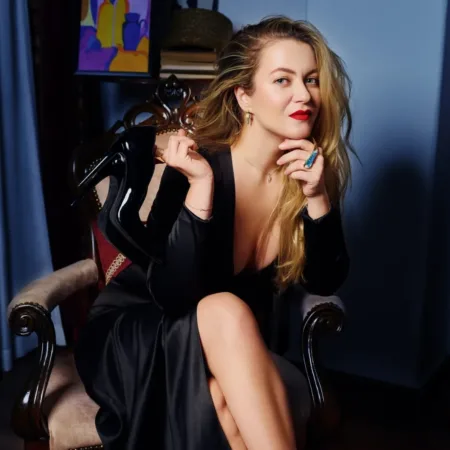

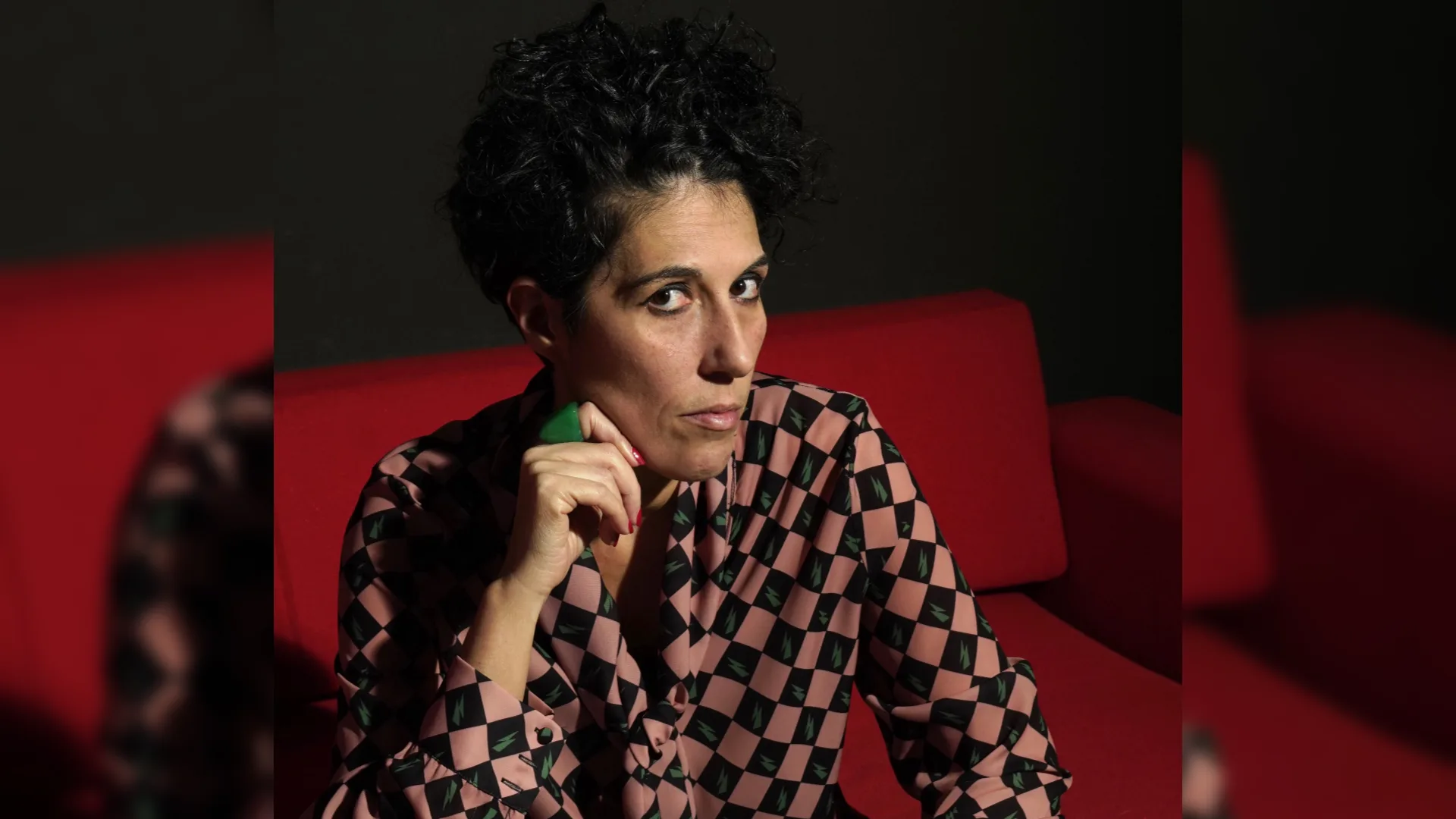
Cristiana Giacchetti – Lyricism as a Form of Rebirth
In a world that often celebrates speed over depth, Cristiana Giacchetti invites us to pause — to feel, to reflect, to remember who we are beneath the surface.
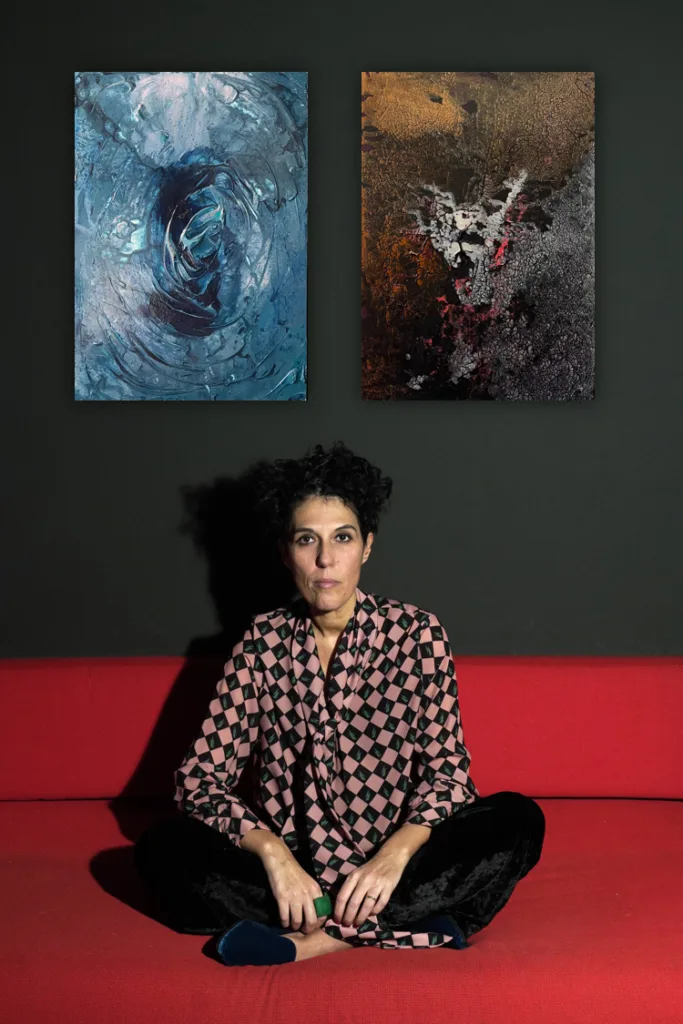
Born in Italy and shaped by a lifetime of inner search, Giacchetti returned to art in 2021 after more than three decades in strategic communication and personal development. Yet her creative path was never truly abandoned — only waiting to be reborn. With roots anchored in the legacy of her great-grandfather, a fresco painter, and her father-in-law, a visual artist, Cristiana’s art seems to breathe memory and mystery.
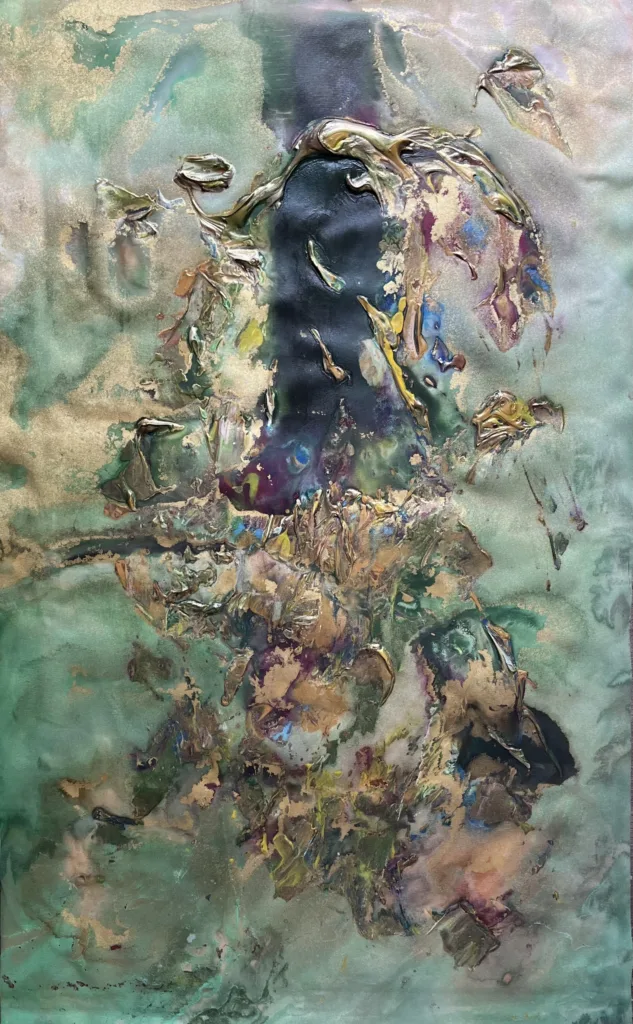
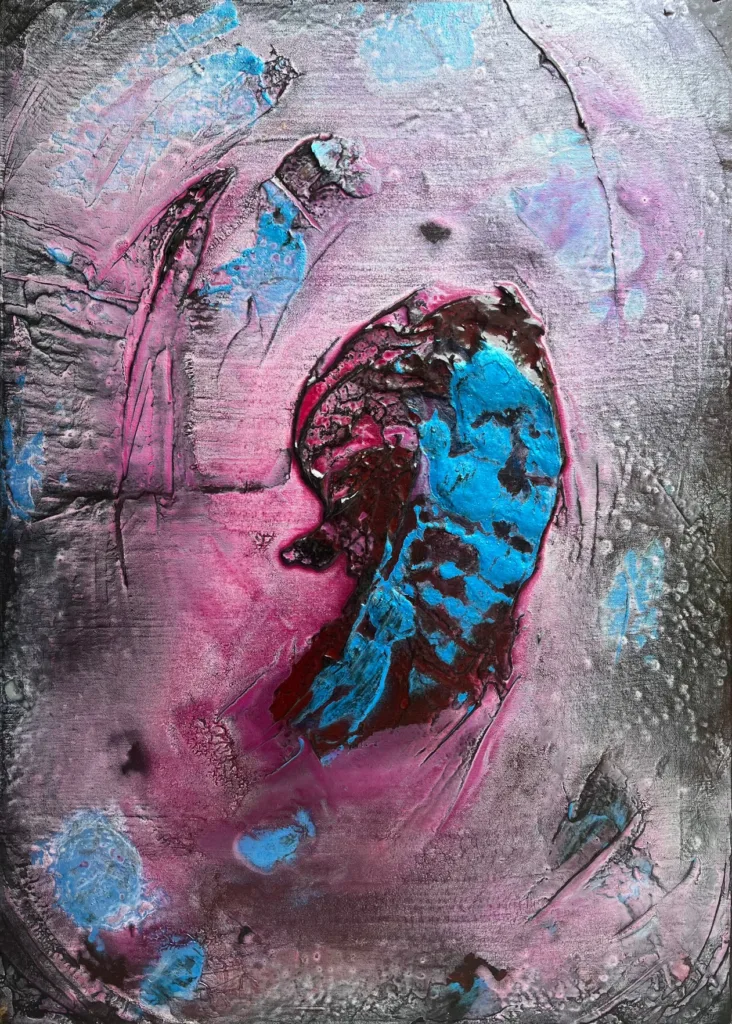
Her canvases are lyrical meditations. Through textures, shapes, and the gentle suggestion of pareidolia, she leads us into landscapes that exist between worlds — at once sculptural and ethereal. They are not answers, but questions whispered through color and silence.
This intimate interview explores the emotional alchemy behind her creations, the interplay between vulnerability and strength, and the beauty of her recent collaboration with Galerie Mystique in Ploiești — a meeting point of vision, soul, and authenticity.
- Cristiana, after a long career in communication and personal development, you returned to art. What called you back to the canvas and color?
I like that you used the word “return” because, even though before becoming an artist, I didn’t make art, for me it was like “returning” home. And in fact art called me to itself, like a demon that wanted to prevail over my rational will, which on the contrary had led me away from my authentic nature. That demon wanted to be redeemed and transformed into a creative God. So that god led me into the darkness of depression. Art was the inevitable therapeutic response, an intense dialogue with my dark side that supported me in giving shape to what I mistakenly defined as “discomfort”. The more I painted, the more that apparent “ugliness” became “beauty” in the form of a work. It was liberating because art freed me from the dogmas of the mind that imposed on me an idea of who I had to be. It also helped me free myself from the judgment on my artistic nature and to understand how much beauty there actually is in what we judge as discomfort, for example sadness, melancholy or even depression. These are emotional states of deep inspiration for an artist, they are demons that lead you to descend into your inner caves to ascend with a work of art. In this sense the painting is nothing more than a sublimation of an artistic pathology, just as the pearl is the disease of the shell.
- 2. There’s a deep inner vibration present in your works. What role does introspection play in your creative process?
Introspection is the vibrant pivot of my entire creative process. In some ways I define my art as a sort of radical mysticism. It is no coincidence that many mystics of the past were also 360° artists. Just think of the great abbess Ildegarda di Bingen, painter, writer, composer as well as spiritual guide. Art has always been, as Sant’Agostino himself stated, an instrument of spiritual research, or of connection with the divine images that inhabit our psyche and that want to be realized in the physical world. Reason will never be able to understand them, rather it censors them. We can only contemplate them. The rational thought that dominates the current vision of the world has given us progress but also the arrogance of desacralizing existence by leading us to the illusion of being able to control everything, which in fact is not the case. In this sense, art is a great instrument of re-sacralization of our daily life, as a means of meditation and knowledge of the divine mystery that dwells in every human being. So for me art is a mystical journey into epiphanic territories that reveal themselves as they manifest themselves through the work and in revealing themselves tell an experience of personal and at the same time universal beauty.
- 3. You have strong artistic roots in your family. How did your great-grandfather and your father-in-law influence your artistic journey?
For me they are two key figures, not because they influenced my artistic technique but because they inspired my way of being an artist. My great-grandfather Aristodemo Giacchetti, a fresco painter from central Italy, is still a very creatively present figure and, even though I have never met him directly, evocative stories about him live in me, made of deep passion and love for art. Sometimes when I find myself painting I imagine I am him, that he lives in me through every brush stroke of mine. This attitude leads me to detach myself from my ego and to let, in some way, his image cooperate with me in the creation of the work of art. My great-grandfather represents a precious gem in the genetics of my creative soul, which is why I often celebrate him by dedicating my artistic achievements to him. Equally important is my father-in-law, Gualtiero Mocenni, an Istrian painter and sculptor, who recently turned 90, celebrating with a retrospective of his 70-year career. In over twenty years, he has been a role model who has traced my path, as I have learned from him the courage to experiment and curiosity. I can say that both of these figures have awakened in me the spirit of the artist who for many years has been champing at the bit to exist and who then found his form in reality.
- 4. You speak of pareidolia and lyricism in your art. Does a painting begin with a visible form or with a felt emotion?
Each of my paintings is born from an experience and therefore from an image of the Soul. Alchemists said that everything that happens in our reality is a reflection of what lives in our invisible world, which are images that inhabit us, the “arches” as Platone called them, translated into archetypes by Jung. So if you want to change the world out there you must first of all change the relationship with your inner images. Analyzing the phenomena of your life, judging them as wrong, does not help to improve your existence. What helps is accepting them as part of your path of evolution. In this sense, art is a sublimation of intense experiences of existence, converting them into beauty. Art for me is a therapy of form, a change in the relationship with the experienced event, reliving it in a poetic way. Sometimes, after a great pain, I have created works that chromatically and visually told anything but sadness, but rather lightness and poetry. Only at the end of the artistic process can I capture the snapshot of my dream journey, the image that emerged from the ocean waters of the Soul.
- 5. Acrylic and texture play a vital role in your pieces. What are your hands seeking through this sculptural approach to painting?
My hands want to give shape to a struggle. Although I do not know the outcome of my works beforehand, what I know from the start is that the painting will tell of a tension, an internal struggle between who I think I am and who I am, that me that does not want to give up to maintain control and the most authentic part determined to emerge, the Soul, the me without masks. This dimension of the struggle, in most cases, materializes in a strong materiality of the work, as if the image, which is being composed, wanted to emerge from the canvas, acquiring its own corpus with almost sculptural forms. I would say that the spirit is embodied in the matter of the work, manifesting itself to the outside world.
- 6. “Rebirth” is a recurring theme in your work and life. What does it mean to you, personally and artistically?
Humanly, “being reborn” is the true purpose of life and this involves a peaceful relationship with death. Just think that we go through many deaths and rebirths every day, between one breath and another, between one heartbeat and another, between sleep and wakefulness. What in Tibetan Buddhism is called “Bardo”, or transit, to which I have also dedicated a work of art. There can be no rebirth without parts of us dissolving and therefore dying. In my life I have died and been reborn many times, transiting from one idea of myself to another. Perhaps this is why my artistic mission is to lead, through my works of art, the observer to a rebirth. At a certain point I realized that the viewer saw in my paintings always different forms, not necessarily the same ones in the same work. This depends on the person and the moment, as a consequence of the phenomenon we mentioned before, pareidolicity, or the ability of the subconscious to recreate a form through an optical illusion. Some of these re-created images are romantic, others are brutal, others are scary. Forms that arouse emotions and that lead the viewer to mirror themselves in the image in which I myself reflect my inner world. In terms of my artistic mission, this “relationship” of discovery is essential, as my works become a bridge to connect to the psyche of every human being and at the same time nourishment for the Soul of the individual, which wants to manifest itself through the painting. In some way, therefore, the paintings that I create are messages from the Soul, a cure for those who contemplate them because they push the curiosity to discover themselves.
- 7. You’re currently collaborating with Galerie Mystique in Ploiești, a space devoted to authentic expression and soulful art. What drew you to this international artistic connection?
The collaboration with Galerie Mystique was born from an inner enthusiasm and not the result of reasoning. I was moved by an authentic and genuine artistic desire, starting from the name “mystique”. I still remember thinking “Wow, it would be really nice to collaborate together!!”. For an artist who defines her art as an expression of radical mysticism and who aims to investigate the language of the soul, collaborating with a gallery that bears the name “mystique” is an incredible adventure. And then I am always fascinated by places like Romania that convey sensations of profound mystery and sacredness. It is no coincidence that the theme of the exhibition, for which I applied, “Plastic is fantastic”, aimed to sacralize a material perceived in the world as extremely harmful and polluting. I found this approach profoundly intelligent, because it distances itself from false moralisms of blame towards the supposedly “wrong” but rather pushes you to reflect. And I like challenges, so I seized it on the fly.
- 8. You were selected to represent Italy in an exhibition for the Chinese art market. How did you relate to that international context?
Obviously I am very grateful for the attention that my art is receiving especially at an international level and being chosen by the Sino-Italian Design Center, a platform for cultural exchange between China and Italy, as an Italian artist representative for the Chinese market was a very stimulating experience. The main stimulus came from the simplicity of the relationship with the context. I realized that in some cultures abstraction is very appreciated and loved. China for example, unlike other countries, such as Italy, is not tied to a visual tradition and therefore to the fact that a work has an expressive form that is immediately translatable by the mind, and this is normal, given that in Chinese culture there is a natural relationship with emptiness.
- 9. You received the “GM Mostre” award for your work Rinascita. What story lies behind that painting?
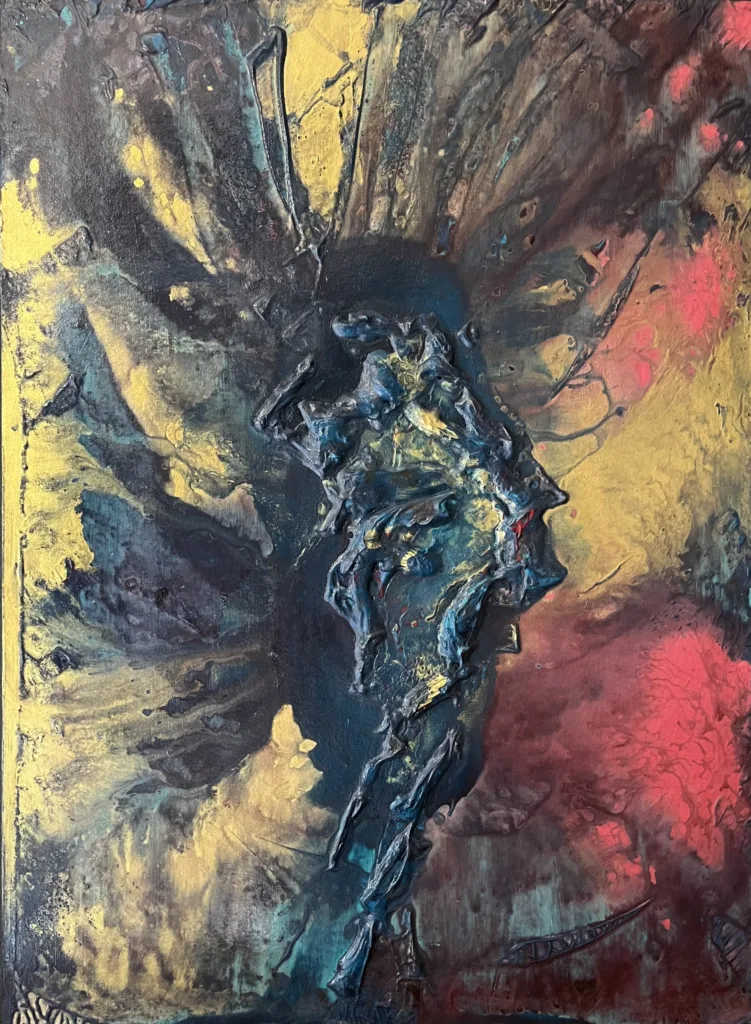
As the title itself says, a rebirth, which as we saw before is the “main theme” of my production. But that work had to seal a very strong passage in my life, in which I had lived an intense period and gone through complex trials. I remember two things in particular about that work. The first is that, the day I created it, I just couldn’t find the flow, in fact I was about to throw everything up in the air, until I saw that shape appear which for me is a Phoenix, hence “Reinassance”, or rebirth. It was a revelation to see it appear. And then, before sending the work to the GM Mostre award, a very dear collector of mine wanted to buy it. But I felt inside that that painting had another destiny and so, with a great weight on my heart, I momentarily refused the offer. My husband called me “crazy” and I felt a little like that too. But that work won the first prize and was compared to the style of Burri’s art, besides the fact that, with the prize check, I earned more than I would have gotten from the sale. Winning that prize was a great favorable sign from the Universe.
10. You’ve also published a novel, merging visual art and literature. How do you write a story in words, and how do you paint one in silence?
I would say that the process, if we want to talk about a process, is the same. In both cases I remain silent so that from the din of my mind suggestions and whispers emerge and my most authentic voice can speak and, in the same way this causes, always from the silence of the unknown, sacred images to emerge that condense into a work. Furthermore, both my works and my novel are mirrors through which the observer or reader reflects images of himself, revealing in this way dimensions of his nature that were obscure and therefore unknown to him. Writing, like art, is an awareness of the invisible beauty that inhabits us.
This interview was conducted through an online correspondence method, with the questions being sent via email. Both parties agreed to this format and to the publication of the interview in the media.
The interviewee is required to attach a minimum of three images, personally selected by the artist, and to give consent for their publication alongside the interview.
Thank you,
Rodica Georgescu